Friday, December 31, 2021

2021 - Thank You Dick Allen

Sometime during the summer of 1973, on a visit to my favorite bike shop, I picked a flyer for a bike ride.  It described a four-day ride from Lansing to Mackinac City, Michigan over Labor Day weekend.  The ride was called Dick Allen Lansing to Mackinac, or simply DALMAC.  It explained there would be maps, a century ride, meals, overnight campsites, baggage trucks, a ride across the Mackinac Bridge, and a bus ride back to Lansing.  The total cost would be something like $200, almost twice what I had paid for my new bike in January of that same year. That ride brochure went on my bulletin board at home.  I didn’t know how I would manage the dollars and logistics, but I decided I was going to do that ride the next year.

Dick Allen at the Michigan Capitol,
DALMAC 74

DALMAC was a complete list of things I had never done.  I had never ridden that many miles in that many days in row. I had never traveled overnight from home with anyone but family.  I had never been camping or slept in a tent.  I had never been north of Lansing, and most of my knowledge of “up north” was from my Michigan history in school or TV, and what I heard from friends. But I don’t ever recall even thinking about those “nevers” as I went about the next 12 months.  It was just all a leap of faith and youthful optimism.

That was my first summer for real cycling.  With Christmas money I had purchased my first drop-bar and derailleur “speed bike” after 3 summers on a 26” wheeled “English” 3-speed.  My longest ride to that point was an 80-mile charity ride, and though my bike was new, I was already planning for my next bike, one with alloy wheels and quick release hubs.  I was working a hodge-podge of jobs, including a paper route, sweeping a small drapery shop on Saturday mornings, mowing lawns and a few weeks of putting up hay on a local farm.  By mid-summer I was washing dishes at a local bar  & grill 3 nights a week, a job that might last through the winter.  

But somehow, it all came together.  Over my junior year of high school, I earned enough money for the new bike, and for DALMAC '74, and was signed up before school was out.  I would share a tent with a high school friend also on DALMAC, but I did buy my first sleeping bag.  I started to acquire cycling clothing, as I quickly learned that jeans or gym shorts weren’t very good for rides of 20 miles or more, along with my first cycling shoes and jerseys.  I bought a set of panniers for my baggage, since you were supposed to be able to carry your gear on your bike.  I was very popular at the bike shop in Jackson, and I never seemed to have a lot of savings!

Finally in late August, my bike and gear were loaded in the family pickup, and my Mom was up with me at 5 in the morning to drive me the 60 miles to the start in East Lansing.  I unloaded my bike, hugged my Mom good-bye, with a promise to call home every night, and checked in at registration.  For the first time, I carried my tagged bags to the ramp of a U-Haul van, and then fell in with the hundreds of riders for the first leg, the ride from East Landing to the steps of the Michigan Capitol building.   From the start, my 35mm camera (I forgot mention I saved up for that too!) was out and I started taking color slides.  As we gathered at the Capitol, walking among the riders was Michigan’s Governor Milliken, in a suit and tie, talking with Dick Allen, who was wearing a polo shirt and cotton hiking shorts.  Most 17-old kids don’t expect to be standing next to their governor, but there I was.

Those next 4 days of bicycling were a blur of new experiences, as I rode north with almost 600 other riders in every type of gear imaginable:  t-shirts and cuts-off, hiking shorts, gym shorts and the few of us in black cycling shorts and real bike jerseys.  There was every type of bike: old 3-speeds, steel Schwinns, and the elite bikes with names like Holdsworth, Bob Jackson, Motobecane and Peugeot.  Regardless of the walk of life, on the road we were all just bicyclists, all riding to Mackinac, all because of a guy named Dick Allen.

Every mile of every day was new to me, each town my first time there, and I had done it all on my own power.  By the second day, I was already in tune with the touring rhythm of RIDE-EAT-SLEEP-REPEAT.  As I pedaled my way north, the changing landscape drew me in even more, until the last day of riding along Little Traverse Bay, Lake Michigan, through M-119’s Tunnel of Trees, and finally the Straights of Mackinac.  I had ridden to the Mackinac Bridge, seeing it the first time and then crossing it by bike.  We arrived in St. Ignace, and made our way to the high school for the last night of camping before our bus ride back to East Lansing, 

On that bus ride back I already knew I would be back.  I thought about all I had seen and learned, and the people I had met.  I was already planning what what I would need for the the next trip, what I had to upgrade, and how to prepare.  But there were things I didn’t know would come out following Dick Allen’s ride to Mackinac.

I didn’t now that bicycling those 4 days would become the anchor in my life through some challenging months ahead.  Rather than more destructive escapes, I would come to rely on a bike ride to get me through the day.

I didn’t know my next DALMAC, the following year, would part of an 11-day adventure of bicycle touring, and the miles of adventures that would follow that trip over the years ahead.

I didn’t know it would kick start my urge to volunteer for bike clubs and events, and the hundreds of hours I would invest in them almost every year since.

I didn’t know that I would pick Lansing as my first town when I left home, all because of it’s great bike club, the TriCounty Bicycling Association, and the lifelong friends I would make while there.  

I didn’t now I would meet my wife to be on one of those TCBA rides.  We would soon begin our own bicycle adventures, riding our tandem for thousands of miles of touring, adventures that continued with boys Tyler and Justin.  And I also shared a DALMAC with Justin when he was just 14.

I didn’t know that life, family and work would result in a 30-year gap between my DALMACs, but coming back in 2008, 2009 and 2017, I was able to say hello again to Dick Allen, and chat with him in camp or on the road, just like in the `70’s.  I can't say I was a personal friend, but everyone who rode DALMAC was a friend to Dick.

With Dick Allen at check-in DALMAC 2017
For 2021, my 7th DALMAC,  I had a great time riding with friends I had made over 40 years before, friends I had made through DALMAC and TCBA.  However, Dick Allen did not make the ride, probably the first time in 50 years.  His joyful presence and smiling face was missed by all.

I know that Dick Allen alone is not responsible for DALMAC, and know most of the people that worked with him in those early years, and the many that still make it possible today. But he is the guy that they all coalesced around.  It was not a memorial ride, he would joke many times on those latter rides.  


If there hadn’t been a DALMAC, it is possible that another event might have had the same impact on my life and my bicycling.  Maybe. But I am forever grateful  there was a Dick Allen and a DALMAC, and that I picked up that flier.  And every time I crest that first hill out of Harbor Springs on M-119, I am once again, and always will be, that same 17-year old kid riding it for the first time.

Thank you Dick Allen, and I wish you smooth roads and tailwinds.


Friday, May 7, 2021

2021: Knitting with Stainless Steel

Yes, I know how to build and true bicycle wheels. 

I would guess most bicyclists today seldom go beyond oiling a chain and changing a tire.  Growing up in a family of boys (and 1 sister) with a Dad who was a mechanic/welder/farmer/heavy equipment operator, you learned early that you always fixed it yourself first (or at least tried to).  And while I didn’t have the aptitude for cars and trucks that my dad and  a few of my brothers had, once I I was hooked on riding bikes, I was soon hooked on working on them.  Building on all that early experience, and my years in bicycle retail,  I don’t mind taking on just about any bicycle repair.  Over the last 3 years, I have even been learning the finer points of disc brakes that are now on our 3 newest bikes.  

Ready to get started.

And every few years, the opportunity comes along to build another bike wheel.  When I started riding, hand-built wheels were in the same league as a hand-built frame, the benchmark of quality and reliability.  And while today’s machine built wheels are incredibly reliable, I still enjoy the satisfaction of lacing and finishing a wheel for one of my bikes when the need arises.

The spoked bicycle wheel is beautiful piece of engineering.  Your hub is actually hanging from the top of the wheel, while the tension on the other spokes works to keep the hub centered in the rim, and the rim true and round.  One of my favorite descriptions is that bicycle wheel is round suspension bridge!  A wheel’s spokes can be laced in a variety of patterns, depending on the intended usage, and what you decide in trade-off’s of weight, performance and reliability.  

While a radial spoke wheel has spoke going straight from hub to rim, very common on front wheels today, most wheels have a pattern that incorporate spoke crossing over and under each between the hub and rim. A 2-cross pattern goes over 1 spoke and under the second, a 3 cross goes over two and under the third and so on (and my reference to knitting).  You must also start the spokes correctly in the rim; the eyelets are offset in the rim, to match with the side of the hub, and you want be sure you don’t have spokes crossing over the valve opening, which can make inflating the tire a challenge.

Once a wheel is laced, the final tension on hand-built wheel used to be more of an art, the proper tension achieved through practice and experience; simply building more wheels and seeing how they held up.   However, when it is years between wheel sets, some of that “touch” is sure to be lost.  And has the design and materials have changed, past experience may not be as useful.  However, time gathered skills can now be aided by tension gauges and software that allow you to measure and compare the tension of each spoke.  I started using the Park Spoke tension gauge and wheel building apps a few years ago, first to repair wheels, and now to build them, and it is an amazing resource.

My first interest in wheel building came about after a challenging couple of days of riding with broken spokes.  I had purchased my second road bike in the summer of 1974, just in time for my first double century and in anticipation of my first extended tour, DALMAC. I was on DALMAC, with probably less than a 1,000 miles on the new bike, when a spoke in the rear wheel broke late in the third day.  In camp that night I found the mechanics truck, and he was able to replace the spoke and true up the wheel.  I assumed it was just a one off, and I would be fine.  (I didn’t expect to be like the tandem on DALMAC that year, that was breaking 5-6 spokes per day, but that is another story!)

I started the next day only mildly concerned.  It was a century day, and would end with biking across the Mackinac Bridge.  At 70 miles, I heard a ping, and a spoke had broken.  It was crossed under another and not causing an issue.   But then at 80 miles, another ping.  This spoke I had remove, because it was hitting the back of the freewheel.  I loosened the rear brake a bit, and continued, trying to ride “softly”.  By the time I reached the pullout for the bridge, 6  (out of 36) spokes were gone, the rear brakes was disconnected, and the tire was barely clearing the frame.   And that is how I crossed the Mackinac Bridge the first time, gingerly riding “light” and hoping my rear wheel would make the remaining 8 miles across the bridge and to St. Ignace High School.

After returning home, I made the trip to the bike shop, and they rebuilt the wheel for me.  This was my first lesson in the art of wheel building.  The spokes used by the manufacturer were smaller than hub was designed for, and the spoke heads were failing at the hub flange.  The shop re-built wheel with a the correct diameter, or gauge, spoke for the hub, and the wheel worked for many years after.   And from the point forward, I worked to learn everything I could about repairing and building wheels.

After lacing comes the finishing.


I started with adding spoke wrenches, I then picked up a copy of Robert Wright’s Building Bicycle Wheels.  As part of a bike upgrade, I bought a set of Phil Wood hubs, then I ordered rims, and the correct length and gauge spokes, and over a week of winter nights, I laced my first set of bicycle wheels while Matt Assenmacher was building my custom touring bike.  A more experienced friend helped me with the final truing, and then the were road ready. I used that the first set of wheels for almost 10 years, before rebuilding them again with a more modern rim.   That set is still on the Assenmacher, probably 10,000 miles later.  

I started the working in bike shops a year later, and was building wheels more frequently, probably 5-6 wheels a year, when a special request would come in, and if the regular wheel builder wasn’t available.  The most challenging wheels I did build were the 5-cross, 48 spoke tandem wheels of the 80’s.  

Along way I picked up the intricacies of selecting the spoke gauge and cross patterns, the lacing order and tricks of when to use lube or Loctite on eyelets and spokes.   The final step in truing was stressing the wheel; wearing a pair of leather work gloves, you worked around the wheel, grasping each the parallel pairs and squeezing so that and twists in spoke is relieved.  When it is done right, the wheel is silent on the first ride, as every spoke is seated and ready to share the load.

My latest wheel, built this past winter, was for the rear wheel my Trek 920.  An errant strap during an after dark commute had resulted in broken a spoke I had repaired a couple of years ago, so that wheel was no longer factory true.  And while cleaning my 920 last fall, I found another broken spoke, as I prepared to replace that spoke I found a crack in the rim at the eyelet of the bad spoke.  The wheel then had over 8,500 miles, and over half those miles had been with my regular work commute load (laptop, lunch and clothes) along with 10 days of self-supported camp touring, so all things considered, including that errant strap, it was not bad run for a rear wheel.  Thankfully, despite the COVID bike and components shortages, the replacement rim was readily available from Trek.  After few weeks to gather the rim and and spokes, the new wheel went together in a couple of nights, first lacing the original hub into the new rim, and then truing it into a finished wheel. The new spokes are stainless steel rather than black spokes, and I already have ridden it for couple of hundred miles since it was installed.

Two of my bike now roll on wheels I have built, and the same tools are used to keep my other wheels round and true.  So while the tools have changed, the satisfaction of the results remain.   While a dozen different technologies are responsible for the component parts, the final product is still handcrafted.


Follow the Ride So Far Page on Facebook

Saturday, January 16, 2021

2020: A 5,000 Mile Miscalculation

In September of 2019, I decided it was time to celebrate rolling over 200,000 logged road bicycle miles. That was when my latest Excel summary spreadsheet had me rolling over 199,999.   Or so I thought.  It turns out I was off, by about 5,000 miles, through a simple error in data entry, the result of combining 4 decades of records scattered across 3 different systems.

Finishing ride in September 2019

Scattered in some boxes, I have all of my early mileage logs.  They are a mix of simple ledger books, Year-on-a-page logs sheets from the League of America Wheelman (now LAB) magazine, and free monthly logs from Bicycling.  All told, I have reasonable approximations of my early riding, especially considering that the first 10 years relied on mechanical peg cyclometers and simple dead reckoning for most of that portion of my mileage history. It wasn’t until 1982 that I had my first electronic speedometer/ odometer from Cateye.  And has a side note,  ever since that first one, in our household, any, bike “computer” has been a Cateye, regardless of brand or capability.  

The first bike computers were clunking affairs, relying on AA batteries, and offering only speed, trip and total miles.  You could actually buy a little external battery pack with alligator clips to keep your milage while you changed the batteries.  Thoughout the `80’s they decreased in size and increased in sophistication, and began their gradual transition to todays offerings with GPS Navigation and tracking, heart rate and power output.

About the same time I started using electronics on our bikes, in 1983 we purchased our first home computer, a CPM based KayPro II. It included a simple spreadsheet program called PerfectCalc.  I used it to begin collecting all those early mileage logs into annual cumulative summaries, with categories for the 4 types of bikes I was riding;  Touring, Sport, Tandem and Mountain.   Those early spreadsheets, and daily records, were my first electronic record keeping, through the late `80s. 

By 1989, I had begun working on a Mac at home, and was also doing relationship data base development professionally, also on the Mac.  So using those developer tools, I put together a bicycle data base that would track my daily miles by bike and ride, and created summaries for annual reports.  I kept adding features; types of rides, the state where the ride occurred, time and distance.  I basically keep that database running through about 2016, which coincidentally, was when I started using RidewithGPS.com.   In 2016 that aging data base database finally hit a platform limit, and unless I spend about $500 for a new license, or until I take the time to rebuild it in a shareware SQL, I was back to Excel.  And that brings back to my 200,000 mile year.

Also along the way, I had to start backing trainer miles out of the road total.  That meant backing about 22,000 miles out of the total.  There is a screen shot of hitting 200,000 TOTAL miles in may of 2015, but that is sort of a sidebar.

My annual mileage summary, circa 2015,
with indoor trainer miles.

My bicycle database had an annual summary, and that included a 200,000 ROAD mile forecast.  Back in 2015, I knew it was going to happen sometime in 2018 or 2019, based on my average annual daily miles (yes, I had that calculated too!).  But I sort of lost track of that forecast with the database.  I then dowloaded some data and began tracking annual miles in Excel.  Based on that work, I settled on September 2019 as the month I rolled over 199,999 road miles.  And I didn’t think much about it until last month of this year.

This year I rolled over 5,200 miles in mid-October, and I wanted to look back at my string of 5000+ years.  So I pulled up the spreadsheet with the summary from the summer of 2019, and started adding things up, and I finally saw that when I built that sheet, I had missed a column entry and 2005 was recorded as 468 miles.  I did a bit of double take, and looked back through a couple of other summary files, and corrected the error (5251 miles), and looked again at the total.   When it was all said and done, I had probably logged 200,000 road miles about the time of the 2018 Hilly Hundred.  It would have been nice to have celebrated it there, but my September 2019 celebration was fun too.  

For now, I have everything agreeing, and I have winter project to rebuild the database, and get a few more totals fixed, like the the total number of rides logged, (almost 13,000) and my average ride (around 16, a lot of 10 mile commutes).  And of course, the milage on each of my bikes.  And then I have my next distance goal to celebrate, in about 5-6 years, when (and thanks to my brother Jeff for the reference), I will complete my first “lunar”.

Follow my Ride So Far Page on Facebook

Sunday, November 22, 2020

2020: Planning a Bucket List Tour Route

My tour this summer from Carmel, Indiana to Lansing Michigan was unique in many ways. A bucket list tour that included stops at my high school and parent’s farm, I was not riding to a typical bicycle tour destination, so there were not many routes available. Touring in the middle of COVID, this was not the time to try Warm Showers, or approaching someone for freestyle camping in a backyard. While I knew from experience there would be no shortage of great back road miles, I still had to find my way to campgrounds, or at least a Plan B motel. On my 2014 tour, along the Katy Trail and across Illinois,  the first time I had tried internet route planning, I had learned a few of the tricks, and a few of the pitfalls. So here is I how I pulled all this together for navigating my tour this summer.
My itinerary on Google Maps


To start planning, I have a couple of rules of thumb that I use as guides. First, every hour by car to reach a destination is the equivalent of a day of bicycle touring. This is especially true if you are camp touring. My other planning guide is “10 miles per hour on the road”: this is not about your speed, this is how fast you are moving toward you destination, after you figure in everything that makes up touring; map checks, finding a grocery or restaurant, topping off water bottles, and a dozen other bits of minutia through out each day on the road. I have had faster days and stretches riding but I have also had 2 flats in 10 miles on the Katy Trail, or a day of 25 mph headwinds in Michigan’s UP. Both of these guides, gained by experience have served me well over many years.

With the above in mind, I had to look at the days available to get to my destination, with one last consideration before I could build my itinerary. My time available only allowed a one-way tour, and I planned to rent a mid-size car for the drive home. This meant I had to have my end point reasonable close to an available car rental pickup. In my case, that meant a mid-sized airport with weekend rental hours. But this also meant I had include an extra day of travel from my rural “bucket” list destination.

Matching this up with my available vacation time, I had 5 riding days, and a drive home day. My rental car pickup would be near the home of friends (and my final overnight), was about 5 hour driving time from home. With all my tour parameters complete, I opened up Google maps, selected the Bicycle option, and started mapping out my overnight destinations. Google maps allows you to create multiple destination routes, and you can take two approaches. You can put in your start and end points, and then insert the waypoints, of just keep adding destinations to the end for each leg. I use the additive approach, and I linked in the first campgrounds I was sure of, and then starting scanning the map between there and my fourth night campground. I then settled on my second night, and I had 150 miles complete with 120 to cover to night four.

Adding destinations builds your route.

To find night three, I starting looking in the overlap of two 70 mile arcs from my day 2 overnight and my day 4 overnight. This covered south central Michigan and the northwest corner of Ohio. Then I began checking the towns for any nearby campgrounds. While I would have liked crossing a third state line, none of the available Ohio campgrounds offered showers or a laundry option, so I settled on a private Michigan campground, with both, on the north west end of my search area. With all my overnights set, I was ready to enter the destinations for days 4 and 5 into Google maps. Next I saved saved a link of the entire route, and copied it into an Apple Notes document.  Apple Notes automatically synched this to my iPhone and iPad. At the same time, I also created another Notes document with a list of my overnights and all their contact information, my reservation numbers, and my car rental reservation as well.

One thing I opted not to do was load the route into my Wahoo Bolt GPS. I reserved my Bolt for simply recording my route and stats, and relied on my iPhone for navigating. I knew my route as researched was intended be a general guide, and I would adjusting on the fly for road conditions, or finding an open cafe with WiFi. While the Bolt’s navigation is very good, I wanted the flexibility for changes without my Bolt lecturing me, and I this would also optimize its battery life.

At the start of each day on the road, I would open my Notes app to the saved Google maps link, and then find my location on the map. I would continue to reference the map as needed as the day progressed. I soon realized I could also utilize Apple Map’s Siri Navigation. By choosing towns 10 to 15 miles ahead ahead on my intended route, I could let Siri call out my next turn. Since I ride with a handlebar bag, the iPhone was within ear shot and and easy reach, and my Watch was giving turn prompts as well. And with a battery pack dedicated to keeping my iPhone charged (a lesson I learned on an earlier tour), that was not a worry either.

For the most part my plan worked very well for this trip. I only encountered a few navigation issues. Both were with my State Parks. In one case, the address I entered entered was for the recreation area office, and not the actual campground, and that added 5 miles at the end of the day. And in another case, while I had the correct address for the park, the campground was actually 3 1/2 miles from the gatehouse. Not a big deal when you are driving, but a little bit more of a surprise for a touring cyclist. That day was typical, with Google showing a 67 mile route, but the miles in and out of campgrounds, and grocery and lunch side trips, my final for the day was 75 miles. All told, my various adjustments added about 5-7 miles a day to the trip, but well within my expectations; I was fortunate this trip to not have any 20 mile mis-adventures to end the day!

Google predicted 67, your mileage may vary!


As for bike route choices, Google seems to have tendency to use state and US highways when there is a paved shoulder, rather than using a parallel secondary road. This worked fine for a quiet state route in northern Indiana, where a combination of rivers and lakes did not leave a good back roads route to my next overnight. Later in Michigan, Google picked a US highway with a paved shoulder that I knew to have heavy truck traffic. In this case the Google bicycle route algorithm apparently did this to avoid 8 miles of gravel; however, I now tour on a bike at home on gravel, and I enjoyed the more direct backroad riding.

My tour planning has come a long way from winging it with state highway maps, and sending letters to bike clubs and highway departments months in advance. Less than 10 miles from our current home is stretch of State Highway that Linda were attempting to ride in the afternoon rush hour, many years ago, and we had no idea were any of the side roads we encountered might lead as we waited for the traffic to quiet. Today, you can pull over, pull up a satellite image, and check out all the options. You still want to research, and be ready for Plan B, but don’t have to ride in the dark.


Wednesday, October 28, 2020

2020: My Touring Gear Updates

New gear, and shopping for it, is always a fun part of preparing for a trip. My latest tour, riding from Carmel to Lansing, Michigan, was no exception. Most of the gear I picked was upgrades to some of my more venerable gear, which also meant a chance to try some new innovations and improved designs. Here are some highlights of my new stuff for this trip.

My Trek 920 loaded to roll.


This was my first extended trip on my Trek 920, but with two weekend overnights and 2 years of commuting, it was not quite new gear. That being said, the 920 provided comfortable for day after day of riding, and I didn’t feel limited by the heavier 29er style wheels.   The 920’s rough and gravel surface capabilities were really appreciated on fresh chip-n-seal and 10 miles of Michigan gravel roads. The 2x10 SRAM drive train handled grades of 13%, with a gear left over, and on the top end, I even enjoyed some 20 MPH+ stretches with tailwinds. I am already a fan of disc brakes, and they were an asset with the extra 30 pounds of gear. This is not a 25mph club ride bike, but I didn’t expect it to be. I am really looking forward to more miles and extended trips on the 920.

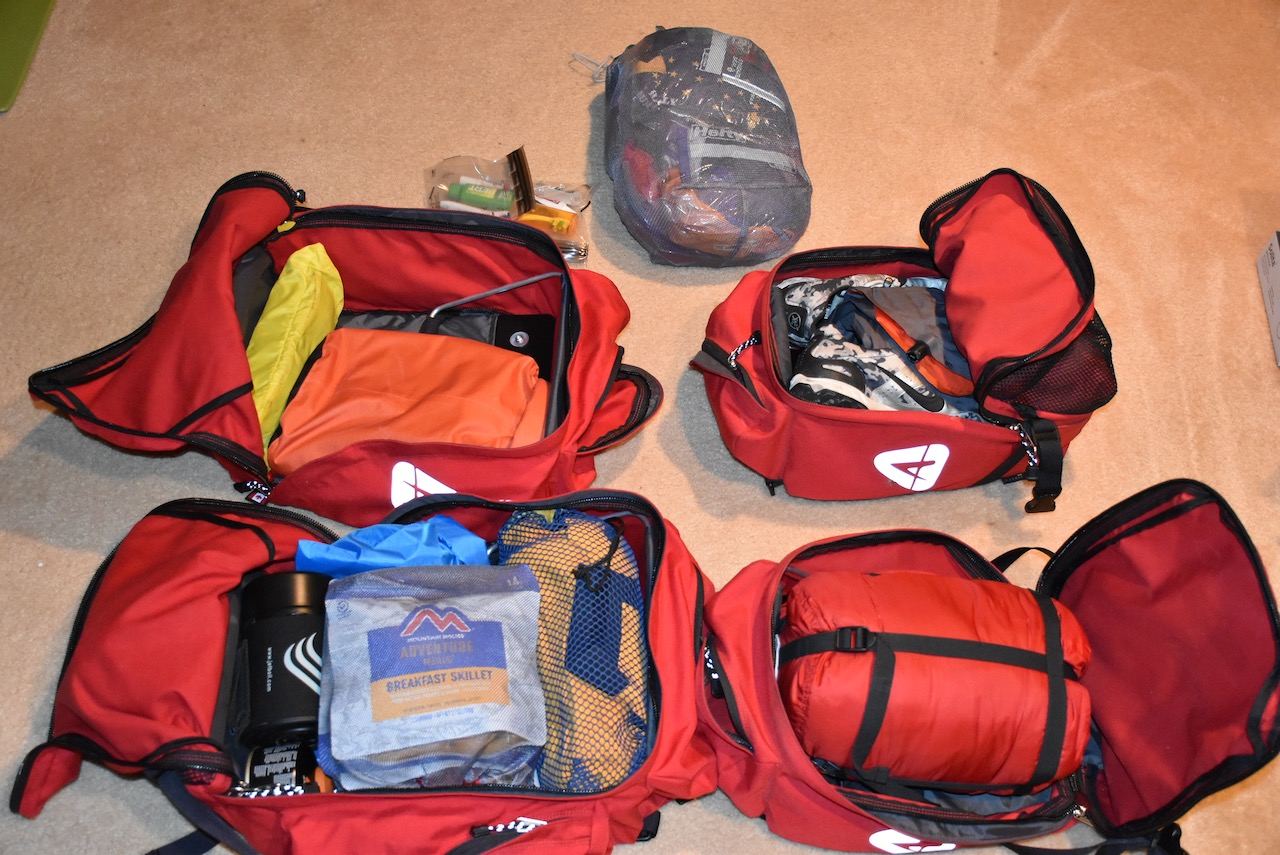
Pre-packing my Arkel panniers


After the bike, my next biggest upgrade were new rear panniers to replace my Eclipse Transcontinentals that we have been using since the early ’80’s.  For new rear panniers,  I went with Arkel's T-42s. With a capacity of 2650 cubic inches, these are are not Arkel’s largest pannier, and they do not have the feature set of their top of the line T-54. They are just a very rugged, basic design with a main compartment complimented by 2 external zipper pockets, and 1 open topped, mesh pocket on the side. I really like Arkel’s Camlock mounting systems, which were 100% compatible with the 920’s standard Bontrager racks.  The main compartment is a 3-sided zipper opening, and there is a hold open bar to shape the bag. These are now matched with a pair Arkel T-28 (1700 Cubic inch) panniers I picked up two years ago, which are used for front panniers and day trips.

Used as a set, the 4 available mesh pockets work great for stuff needed quickly on the road, like sunscreen, a hat, lock and cable, or for stashing stuff that comes off, like arm warmers or a wind vest. I use the zippered external pockets to organize small stuff I want secured but with easy access to during the day. I rarely open the main compartments during the day, except to add groceries. My Eclipse bags had served me well for over 30 years and thousand of miles, and expect nothing less from the Arkel bags.

All the next changes were small items, some for convenience, and some for something new.

The Aeros Pillow was a nice bit of comfort.


Over the years, I have tried a handful of different camping pillows, along with sleeping on a stuff sack of clothing. So when my REI dividend came around last spring, I treated myself to a Sea to Summit Aeros Pillow. Aeros is the first of these option I would actually consider using as pillow at home.  It inflates quickly with a clever check valve that self closes while inflating and opens fully for packing.  The integrated soft, microfibre top cover is the nicest bit of comfort.  In the morning it packs down into a small fist-sized stuff sack.  The Aeros costs more than most inflatable pillows, but hey, that is what an REI dividend is for, and it was worth it. (Sea to Summit has updated the Aeros line since I picked mine up.)

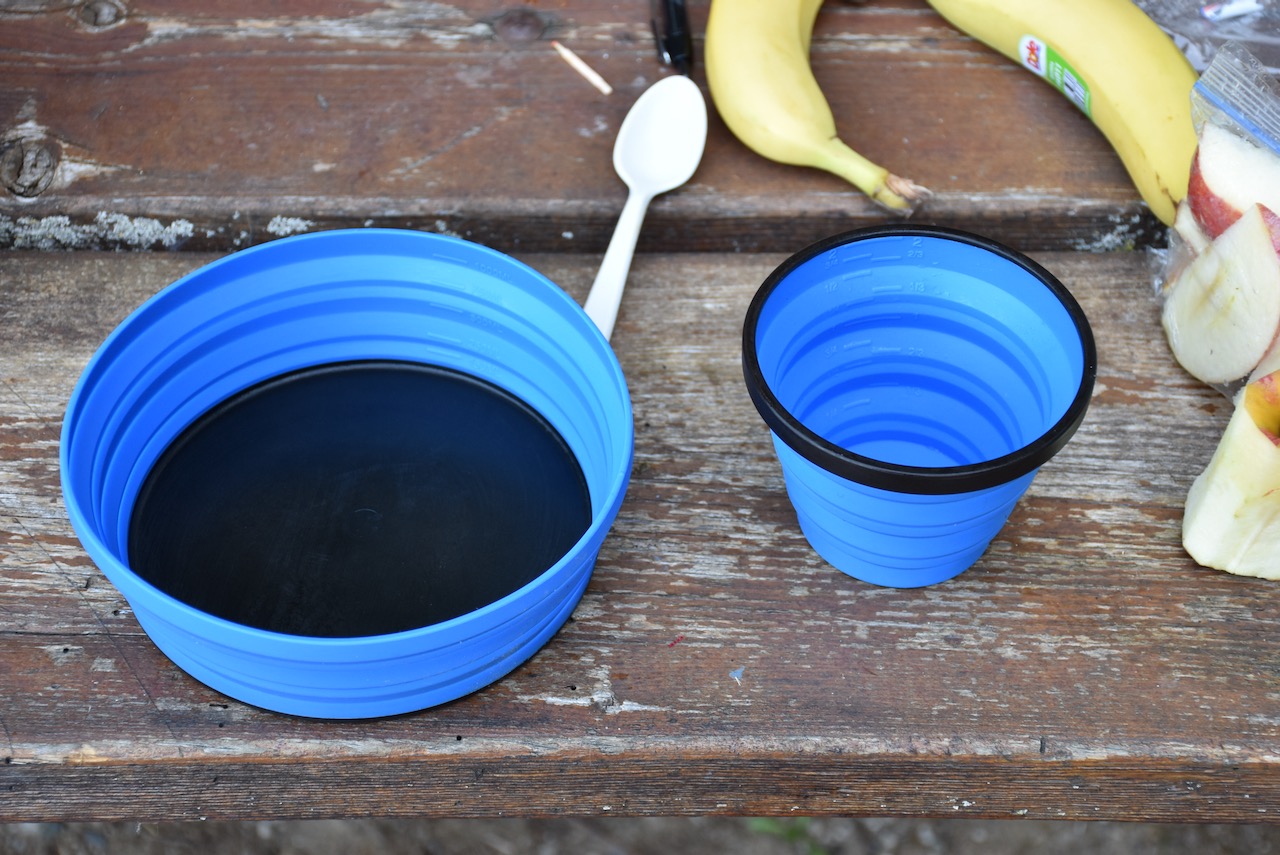
Also from Sea to Summit, I purchased their X-Bowl and X-Cup collapsible dinner ware for this trip. These replaced some generic plastic dinner plates I had used for years. The X-Bowl served as a plate, bowl and even a light duty cutting board for preparing apple slices. The X-Cup was available for use as a drinking cup, and was the right size for my breakfast oatmeal. They are easy to clean, and both packed flat.

Sea to Summit X-Bowl and X-Cup

I use stuff sacks to organize the items in my panniers, and this includes clothing packed in ziplock bags, or pre-packaged meals. To make it easier see what was in each bag, and since the contents were all water proof packaged, I replaced many of my older coated stuff sacks with mesh stuff sacks. Aside from a couple I already owned, I picked a couple of REI Co-op Mesh Stuff Sack, a 5 Liter and an 8 Liter. They feature a convenient one handed closure, and are great value. Being able to pick the item I wanted without emptying the entire bag made camp life a little easier.


And while I use household Ziploc freezer bags for clothing, I added an assortment of 4 LokSak waterproof bags. I already a pair each of their phone and 8x5 gear bag from ride swag (Thanks DALMAC!). The are much tougher than even household freezer bags, and feature a heavy duty double water proof closure. I used them for my shower kit, a mix of small electronics, including an iPad, and one for my iPhone. They last a least a couple of years of daily use, and will pick a few more before my next tour.

Another upgrade this year was Black Diamond Cosmo Headlamp, replacing my much older first generation LED headlamp. While I am carrying 2 bicycle headlamps, they are overkill when looking for stuff in the tent, and you can’t beat a headlamp for hands free in camp chores.

I also switched to a new microfiber camp towel from REI. It’s a much softer feel than my old cellulose based camp towel, and it drys fast and packs smaller. I also added a Matador Mini Pocket blanket, which came in handy as a table cloth for damp picnic tables.

The last thing I will mention here is a pair of NiteIze CamJam Snap Hooks, paired with 25 feet of 1/8 nylon cord. I used this for a clothes line each night, and they quickly adjust to almost any combination of trees and structures you are likely to find. It was much easier than trying my skill with knots. I also used a bright orange cord, which is less likely to be forgotten when packing up.

So that is quick review. i was really pleased with how everything worked. I need to write updated gear list this winter, and I might even write about the 4-5 things I will leave at home the next time.


Sunday, October 4, 2020

2020- Indiana to Michigan Tour Summary

Here are the links to all the blogs about my tour this summer from Carmel, Indiana to Lansing, Michigan. This trip “connected the dots” between my riding in Indiana and the Michigan roads where I began my riding as teenager. With this trip complete, I have a contiguous personal heat map of rides in Michigan, Ohio, Indiana, Wisconsin, Kentucky, Illinois, Missouri, Iowa and Nebraska.
 
Wrapping up breakfast.

The 5-day, 360 mile, self-contained camping tour was on Indiana and southern Michigan back roads. I planned the route through 3 State Parks and a private campground, using Google Maps bicycle option for the basic trip plan, and then used a combination of Apple Maps and Google for in route adjustments each day. (I will do a future blog on trip planning tips and techniques.) Each day’s breakfast and dinner was cooked in camp, and lunch (or lunches!) were found on the road; I always followed my 3 meals on the bike rule.

Many aspects of this trip were bucket list items, which I expected to complete over the next few years; connecting to my Michigan miles, a ride from my home to my parent’s home, and riding to a high school reunion. Then COVID 19 canceled all the vacation and bike events my wife Linda and I had hoped to attend. I began planning the trip in early June, when the combination of 7 months without a vacation, the need to burn some accumulated vacation time, along with other factors, made this this a good time to make this trip.
Close to home!

When I asked about the route by non-biking friends, the most common question was “Did you ride up Instate 69?”; it is a revelation how many people have no concept of the available country backroads and byways most bicyclists take for granted. Many also assumed that Linda was driving along for the overnights, and were surprised not only by the daily distance, but that I was riding alone and camping.

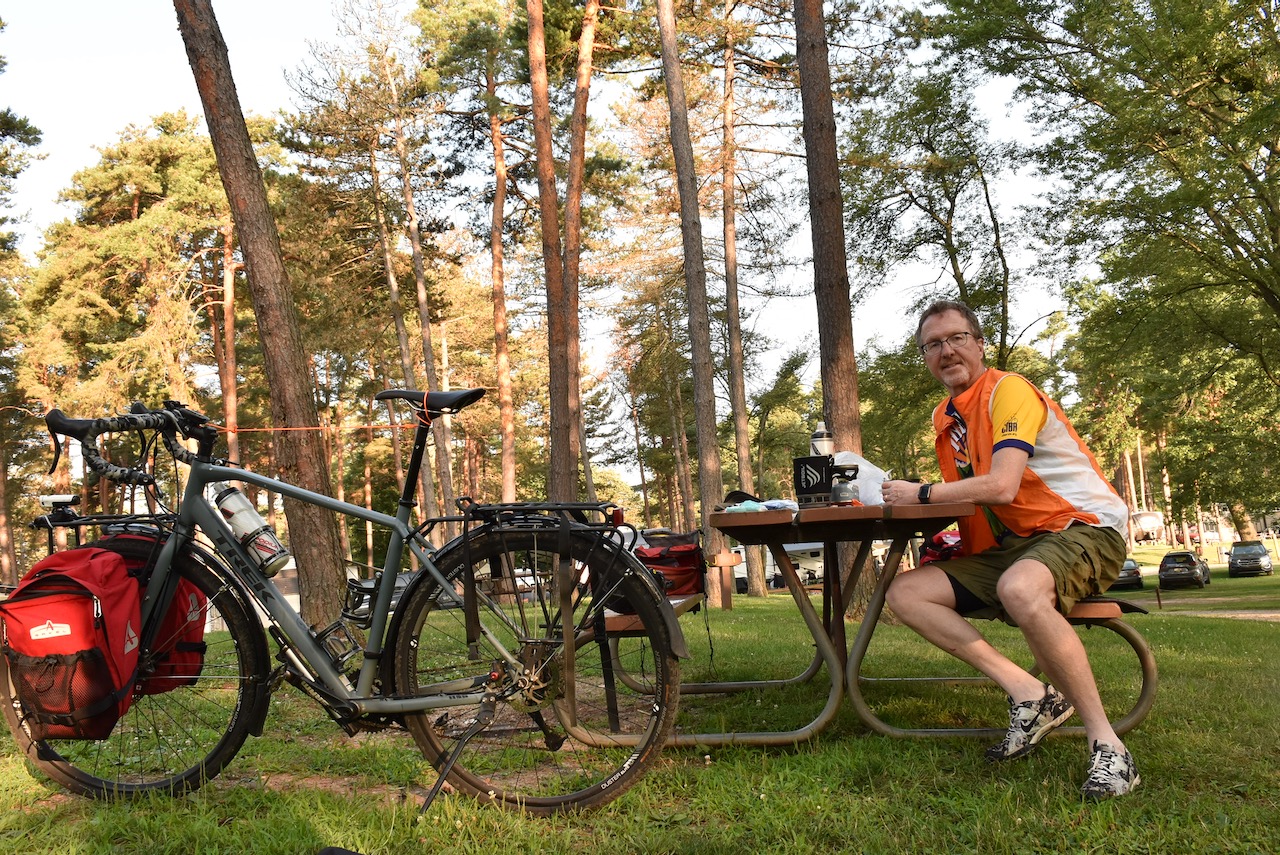
Almost 2 months later, each dinner in camp, morning in my tent, and day on the road is still fresh in mind. A picture of one of my campsites, with tent, bike and breakfast on the picnic table, is now my screen saver and meeting back drop. With everything that has happened in 2020, it is good to have that to fall back on.

In to the mitten!


2020: CTD-Pt2 - Day 1 - Old routes a new way
July 21, 2020: Carmel, Indiana to Miami State Recreation Area, Wabash, IN - 76 Miles

2020: CTD-Pt2 - Day 2 - Riding Off My Map
July 23, 2020: Miami State Recreation Area to Chain of Lakes State Park, Albion, IN 75.2 Miles

2020: CTD-Pt2 - Day 3 Into the Mitten
July 23, 2020: Chain of Lakes State Park, Albion, IN to Union, Mi, 75.8 Miles

2020: CTD-Pt2 - Day 4 - Reunions and Reflections
July 24, 2020: Union, Mi to WJ Hayes State Park, Onsted, MI, 58.5 Miles

2020: CTD-Pt2 - Day 5 - All Good Things
July 25, 2020: WJ Hayes State Park, Onsted, MI to Lansing, MI, 65.7 Miles


And by the way, CTD Pt2 (Connect the Dots, Part 2) refers to my first Connect the Dots Tour, Columbia, MO, to Covington, IN in 2014.


Tuesday, September 15, 2020

2020: CTD-Pt2 - Day 5 - All Good Things

Day 5 - Connect the Dots Part II

After leaving the Farm, it was another 3 1/2 mile to Hayes State Park. Along the way I passed our former home at the lake, and the spot where my grandparent’s hotel had once stood on Lakeshore Drive. It’s a mile long, and the narrow road lies between many of the cottages and their docks and a narrow strip of beach on Wampler's Lake.  There was a lot of activity at most of the cottages as their owner prepared to open for the weekend. I then went back to the main road and continued on into the state park.
Could you resist?


Even though Hayes State Park was just a couple miles from my childhood home, this was my first night to camp there. Growing up, the state park was something summer people did, and since we had access the lake and dock at the Hotel, I hadn’t been in the park until my late teens. I visited a few more times since, taking Linda and our boys there for swimming and hiking during family visits.

I had an online reservation through the Michigan DNR, which was good, since this was my first weekend night on the road, and a “Campground Full” sign was at the gate. At the gatehouse, the staff was really thrown off by my lack of a “vehicle”. They asked my name, and then just told me my campsite number. I had to ask for a map, and then I started pedaling back to my site

A quiet morning on another lake.

In the full campground, I was the only touring bicycle, and all my “neighbors”, and many of the people walking by, had questions for the guy with just a bicycle and a tent. A couple at the site next to mine offered me a frozen bottled water, (which I used to chill my bottles overnight). Another guy from the site across the drive came over to chat and was fascinated by my Trek 920. Even though he was a “car” guy, he wanted to know about the wide tires, disc brakes and the non-traditional frame on an apparent road bike. Everybody that walked past was social distanced, though you could tell there was a natural tendency to want to move closer. And in chatting, it turned out many of the people I talked to were camping and RV’ing to avoid crowding family homes or traditional hotels for family gatherings.

Charging up for the last day.

Once I had my tent set, I rode out a few miles to a quick shop for a few dinner items. I picked up a Jiffy Pop, a large cup of ice and a bottle of Diet Coke, and a Gatorade to start the morning with. I then headed back to my campsite, cooked my dinner and ate. The Jiffy Pop over the JetBoil turned out to be a disappointing fail, and I will have to research that a little more for next time. With all the conversations and the trip to the store, it was well past sunset before I finally went for my shower, and then crawled into my tent for the night.

I slept well in the campsite, and woke at sunrise without an alarm for my last morning in camp. Breakfast was another home mixed oatmeal, and I finally finished the last of my fruit from my Wednesday shopping. Dropping off my trash on the way out of the campsite, I realized a young raccoon was trapped in the nearly empty dumpster, and I let the gatehouse staff know on the way to the main road.

5 miles of new pavement!

It was a beautiful early morning to be riding, and I even had light tailwind out of the south. On the way past the Farm, I was able to say hi to my sister and niece, who were busy working on updates to the house they would soon take over. After a brief visit, I continued on my way. Every road would be familiar for most of the route to Lansing, and it was rural Michigan riding at its best. It was mix of farms, woods, lakes and marshes for the first 20 miles, as I rode north through Norvel and Grass Lake.

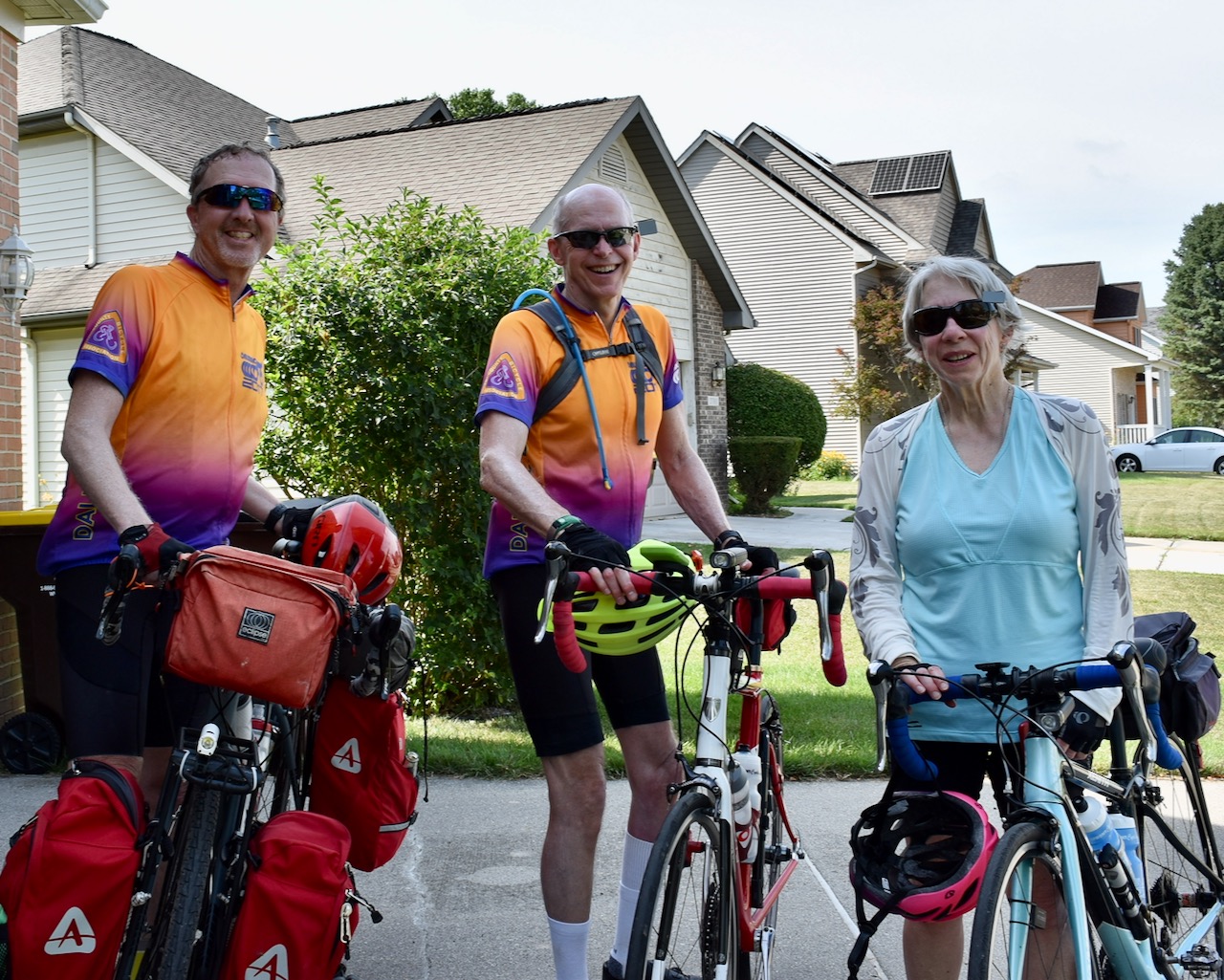
Along the way I started exchanging texts with my friend Steve, who was going meet me enroute between Jackson and Lansing. We tweaked our converging routes via text, and finally connected a few miles outside of Leslie. Despite the miles between our homes, Steve and I have managed a ride together every summer since 2006, including multiple DALMACs, TOSRVs, a RAIN, and handful of Hilly Hundreds. With everything canceled, the tour was our connection for 2020. And just by coincidence, Steve showed up in the same DALMAC jersey I was wearing.

The courthouse in Mason, MI

We were quite a contrast, Steve on his bare road bike, and me loaded for the week on the road. We looked like the King and the Squire from Monty Python’s Holy Grail. I joked with Steve that if anybody asked, I would just say I lost the coin toss. We stopped for lunch in Leslie, and there we coordinated our next connection with Steve’s wife Maria, who would meet us in the next town up the road. We met her in Mason, and stopped for MSU Ice Cream on the town square. Along with my ice cream, and this being Michigan, I also had a bottle of Faygo Root Beer, and collected the last cap* for the trip!

And that's why we love Faygo!

From Mason, it was a dozen or so miles to Steve and Maria’s house, riding many familiar roads from my 2 years in Lansing. This was the last day of the trip, and for first time since Monday night, I would be sleeping indoors. My box of clothes for the drive home was waiting for me, but before I showered, I unpacked and laid out my tent to dry. I was also able to start a load of wash, and all before Steve pulled the pork steaks off the grill. We relaxed over dinner with stories and family catch up. It was a perfect evening finale to a trip planned under the strangest of circumstances.

Sunday’s plans were up in the air, until Enterprise car rental called and asked if a full size SUV, available in 2 hours, instead of Monday, and at the compact car rate, would be okay! I said yes, and we drove out the airport to pick it up. It was HUGE, but that meant no bike disassembly! With my transportation home settled a day early, the 3 of us did an easy lunch ride to the MSU campus, on the very nice trail network south of Lansing. After a week, it was fun to ride a nearly empty bike, especially with friends.

Back at Steve and Maria’s, my personal baggage truck was easily loaded with my bike and all my gear. My unexpected journey was coming to an end. Everything had worked better than I could have hoped; my bike, my gear, my body and the “from scratch” route planning. It is a great feeling to be able to drop into an ‘On the Road” routine in just one night, and to ride day after day, and still look forward to the next. And best of all had been the people along the way, with their friendliness, interest and support. I can’t wait for the next journey, when ever, and where ever, that might be.

Myself, Steve and Maria Lieby - jouney's end.


Day 5 - Hayes State Park, Wampler’s Lake, MI to Lansing, MI
  • 65.7 Miles
  • 357 Total Miles
  • Total Time 07:52:39
  • Riding Time 05:21:05
  • Avg Speed 12.3 mph
* 14 Gatorades and 1 Faygo!