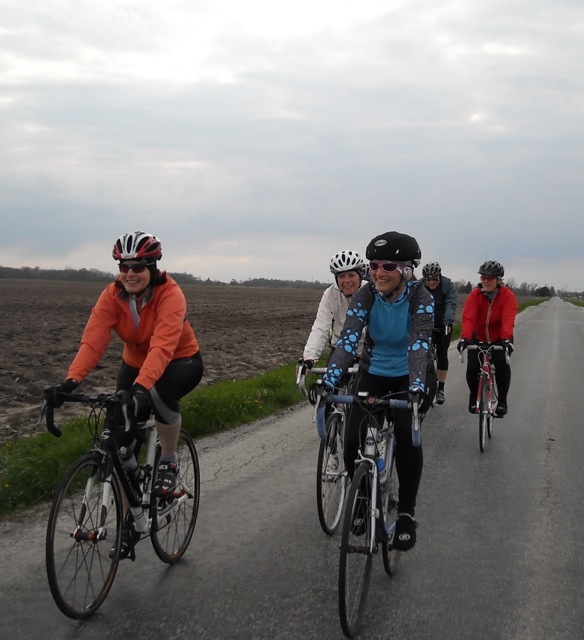
Wednesday, May 14, 2014

2010: Why do we do the crazy rides, for no sane reason?

My training is complete, I have my base, and after 35 years of this, I know how to ride back-to-back centuries.  If I can ride 70 miles, I can ride 100, get a good night’s sleep, and wake up and do it again.  And yet here I am on a cold, wet, windy day, knocking off another century, to be sure I was ready.

Storm clouds ahead - how bad can it be?
There were so many reasons not to do this ride today.  And they were all reasonable.  I would be riding alone.  Dopler was showing a sea of green to the west.  (What did we do before Dopler?  We were crazier because de didn't know? Or was ignorance bliss?).  I could knock out a fast 30 miles, return home to work at my desk, and grab more miles during the week.  There was no reason to be out riding in the rain.

But I had said on Facebook I was riding a century on the last Sunday of April.  I had completed this ride 5 years in a row.  It was somewhere between habit and tradition; my door-to-door century, rolling out of the garage, and rolling back in 100 miles later.  I had started it alone, the next year brought along my oldest son Tyler, then inviting friends along for the next 3 years, as the “Tour De Mulberry” was born. Now, with the first rain-out, it was full circle; riding alone, working to get 50 miles out so it would be 50 mile home.

Mulberry - 52 wet miles from the end of my driveway.
Alone I rolled out into the rain.  At 20 miles out, I turn around and start to head back, but the rain actually eases, and after just a half mile, I resume my my ride to the 50-mile turn around point.  Of course, the weather got worse after half way.  Yet it was never a hard rain, never a full headwind, never too cold.  I was dressed on the edge of hypothermia, not able to stop too long. The constant pedaling was balancing my body temp on a knife-edge, against wind and rain that found a new way under my jacket with every turn.

When I finally step off my bike, at 105 miles, almost 8 hours after leaving home, the act of stopping and stripping off wet clothing is enough to start a bout of violent shivering that didn't stop until I had been under HOT water for 5 minutes.

It was a totally insane day to ride.  It will hopefully be my worst ride of the year. It was another personal challenge given and met. And it was a perfect.

(Since 2004, the last Sunday in April has been my final "training ride" for TOSRV, the Tour of the Scioto River Valley, a 2 day, 210 mile ride in Columbus, OH held Mother's Day weekend. As of 2014, I have ridden TOSRV 14 times since 1979.  And I have made the ride to Mulberry 4 mores times as well.  A version of this blog was originally published in April of 2010.)

Sunday, December 8, 2013

1974: First Double Century

The patch says it all.
There is just something about the eternal optimism of youth. After barely a year and half of cycling, and just a couple of months after my first one day hundred mile ride, I was ready to take on 200 miles in a single day. To be precise, it would be 200 miles in under 24 hours, but under the League of American Wheelman (now Bicyclists) “rules”, a century had to be completed in 12 hours, so a double could be completed in 24.

The ride was the Cloverleaf Double Century, hosted by the Jackson Freewheelers of Jackson Michigan, my first bike club. I have written of them before. The Cloverleaf and the Freewheelers are no more, but they were both a big part of those early summers that cemented my love of bicycling. I journaled most of this ride in the weeks and months after the ride, recording miles immediately, and then recollections in detail later. August of 1974 was quite a month.

The ride was called the Cloverleaf because it was four different 50-mile loops, originated from a community college campus a few miles south of Jackson, Michigan. To add to the challenge, the ride actually started at Noon, to force you to ride at least one loop at night. The ride was also in early August, so we didn’t even have the advantage of a long summer day in Michigan. When you consider the precautions most organized rides take with night riding today, you are reminded it was a simpler time.

I drove to the start of the ride with John Whitehead, the other crazy cyclist in my high school. Since I was not yet 18, John was my in loco parentis for this ride, as he would be in a few weeks on my first DALMAC, a 4-day bicycle tour over Labor Day. He also brought along the tent we would be using on DALMAC, and this would be the first night I tried sleeping in tent, if, and when, a chance to sleep came.

We unpacked our bikes and finished signing up and started the first loop just a few minutes after noon. There were about 200 riders heading out in a soft mass start, and we were riding somewhere between the fast wool and leather helmets (this a few years before lycra) and ahead of the T-shirt and cut-off jeans riders. That summer I had my first pair of cycling shorts and a jersey, both polyester, and with a leather chamois in the shorts. I had a pair of black leather cycling shoes, and had even found some cleats to nail to the soles, cobbling one of the unexpected skills I had picked-up that summer

In the first 10 miles after leaving the college, we settled in with a group of about 15 riders, but it turned into a comedy of sorts for a couple of minutes. Three riders about my age in the front decided to start handing back and forth items from their seat bags, re-arranging who was carrying their spare tubes and tools. (I am not making this up!) By then, we had a couple of cars backing up behind us, and some of the riders starting yelling for the threesome to get out the way. That is when a fast group of riders coming from behind started passing the cars behind our group. Finally, after some yelling and honking, one of the threesome finally dropped something, and then they all pulled off to the side of the road, and we were moving along again.

I would latter have my own little traveling fiasco, as one of the sandwich bags I had carefully filled with trail mix before the ride proceeded to split open when I tried to open it while riding, dropping raisins, nuts and M&Ms into my front wheel and fountaining them in the air. After that, I left them in my pocket, or only ate at stops.

John and I rode the first 50 together, finishing in about 3 /12 hours, but I was feeling better then him at the end. I headed out after about an hour of snacking and making sure the tent was up, but he decided to rest longer. I was on the road by 4:30, for the next 50 miles. This loop was pretty uneventful, but I did talk to a hand full of riders from across the state, and few who going to be on DALMAC in two weeks.

I finished my first 100 for the day at 8 PM, just before before sunset. I ate more food, and started getting myself and my bike ready for the night loop. I had two French-made Wonder lights, a flat while plastic flashlight that used these weird, flat batteries about the the size of 3 AA cells, for a 4.5 volt flashlight. About the only thing notable about them, other than their being French, was that they were designed for bicycling, and they had adjustable clamps that could be fit around handlebars, with a ball joint allow you to aim the lights. They put out a small puddle of light about 2 feet in diameter and 10 feet in front of your wheel on the road in front of you.


The Freewheeler Club patch.
I also had a leg light, which was another French made, plastic flashlight that strapped to your leg below the knee, with a single bulb lighting a clear lens facing forward forward and red facing back, all powered by two C-cells. Besides that, I had an oversize truck reflectors bolted on my bike's rear rack. This was state of the art bicycle lighting for 1974. I saw another rider who had a home-built 12-volt system (but it only lasted about 25 miles). Other riders were using generators lights, but I was above average in having two headlights and some extra batteries, but more on that later.

I set out at 10 PM, adding a sweat shirt and sweat pants, (both dark blue, of course) over my jersey and shorts. I did have white tube socks on. (No mention of any helmet in my journal, which I think is still a year off at this point.) There were Dan Henry’s painted in the road, and I knew some, but not all of the roads we were on.

I rode the first 25 miles to the half way food stop with two Dave’s, one who had 12-volt generator that had enough light for all 3 of us, so I was able to only run one of my Wonder lights. Even with that, we added two miles when we missed a turn, and were only averaging about 10 miles an hour at best, arriving at the halfway point about 1 AM. Progress was slow as you stopped at every intersection to check the road signs and maps before moving on.

At one point, one Dave began to tell the other Dave that once you rode over 12 hours, it was obvious you would be in pain and agony, and they discussed the aspects of this for next several miles. First, I wasn’t in any pain or agony; I was actually having the time of my life! Nor could I couldn’t understand why anyone would continue to do something they felt would cause pain and agony. We also encountered another rider who had missed turn and ridden into a pond, but had somehow managed not to drown, and recover his bike and continue riding.

While Dave and Dave continue to carry on about pain and agony, I left the 25/125 mile stop on my own. This was in rural south east Michigan, on almost moonless night, 25 miles from Jackson, the nearest large urban area. I was riding past small lakes and marshes, on almost level terrain, with just my 1 or 2 small pools of light, and the yard lights of surrounding farms; with very few cars after 1 AM. That is when the riding took on an almost mystical quality of sitting motionless on my bike, under a giant dark blue bowl that was slowly moving over my head. I was also struck for the first time on how much light there was riding under the stars on night like that. They were some truly magical moments of riding, and I have always enjoyed night riding since.

I was fortunate to still have lights and batteries at 40/140 miles after 2 AM, because that is when most of the battery lights began failing for the other riders. I came up on one group of 4 riders that were down to a single arm & leg light on their leader and no headlights, almost clipping the last rider while focused on my headlight and the light of the leader. I offered to guide them in, but they said they were doing fine.

I finally got back to the campus at 3:30 am and checked in at the control. I headed to my tent, and woke up John, who it turned out, had not left yet for his third loop. He headed out, and I took over the tent to sleep. I slept until 6:30, and then after a peanut butter and banana sandwich (“a breakfast of champions” I wrote in my ride journal,) I was back on the road for the final 50 miles.

This loop was riding toward home, along all the familiar roads around Norvell, Fay Lake, on through Brooklyn, and past my high school. Along the way, I got to surprise my Mom and one of my younger brothers, who were covering my Sunday morning paper route in Brooklyn. After leaving Brooklyn, I even picked up with a pace line of 20 riders for a bit, something still new and rare for me.

I finished back the college about 10:30 AM, just under 4 hours for the last 50. My total time was just over 22 hours, with a riding time about 16 hours. All times were by wrist watch and peg cyclometer, there were no electronics to record distance or time. We packed up and headed home, where I slept and napped for almost 18 hours, only waking for dinner Sunday night.  I was back on my bike Monday, and continued riding and prepping for DALMAC, just  few weeks away.

I have ridden over a hundred and thirty* centuries since, including a couple more one-day doubles and a couple of RAIN (168 miles) in the years since. The contrast between the preparation and gear of today with that long ago ride never escapes me. There was such a pure innocence and ignorance when I set off that afternoon; but the accomplishment and knowing of what I could do and experience on a bike has never left me.

(*As of December of 2023, that total is now over 170.)


Sunday, August 11, 2013

2013: Bike Tuesday

It is not on any ride schedule or calendar.

There are no Dan Henry’s.


There is no map.


There is not a sign-in sheet, waiver or release.


There are no incentives or rewards.


It it not the largest ride.


It has never been ranked by a magazine.


It's just a weekly gathering of friends to ride.


And there is no better place to be on a Tuesday night.

Tuesday, July 23, 2013

A ride on the Nickel Plate Trail

The Nickel Plate is over 34 miles of trail.
For the third summer in a row, Linda and I made a trip north to ride the Nickel Plate Trail. This trail runs from Cassville, just north of Kokomo to Rochester, Indiana. In 2011 and 2012, we took our boys Tyler and Justin along to ride the southern and middle sections of the trail. For this year’s excursion, we invited some our cycling friends from a couple of different groups we belong to, with the intent of researching for a future larger outing.

A paved rail trail, the Nickel Plate parallels US 31. Rochester and Peru are the two largest towns on trail, while Denver Indiana, about 9 miles north of Peru, is a small four corner town that is also a trailhead. Crossing the two river valley, the Nickel Plate offers a variety of terrain, as you climb up out the river valley’s, and then off the bluffs onto the surrounding farmland. This also means there is always some shade coming up along the trail at any time of day to let you enjoy the any time of day.

For our latest outing, since we were unsure of Linda’s final miles, we set up a progressive start with our friends; we would meet 1 couple in Denver, about halfway up the trail. Another couple started and hour and a half before us in the morning from the southern end at Cassville. Our fourth couple started from the Lovers Lane (really!) trailhead north of Peru. This was all coordinated with texts, emails and few calls the day before and as we drove up. And it all worked out, the 8 of use arriving in Denver within in 10 minutes of each other.

Meeting our friends in Denver.
We all headed north from Denver for Rochester, currently the northern end of the trail. It was a beautiful day for riding, and overnight cool front having knocked down the heat and humidity from earlier in the week. After a short stretch of shaded grade out of Denver, it was easy rolling to Rochester, a 16 mile ride. A treat there was an additional mile and half of new trail not on the map, that took us right to the edge of town. From there it about about a mile of side streets to our lunch destination, the Streamliner restaurant, just off the classic town square.

We enjoyed a classic midwest lunch of cheese burgers and tenderloins before starting our run back down the trail. While by no means crowded, we did see other riders in almost every section of the trail throughout the day. After returning to Denver regrouped, and we all decided to head back down the trail to Peru, in the search of ice cream.
The Ultimate Tenderloin at the Streamliner 

The next 7 miles were were an easy grade up and through the river hills on the north side of the Wabash River and Peru. There is no trail through Peru yet, so we followed road markings into town. With a little help from Siri, and finally, a lot more help from a local police officer, we found Peru’s best ice shop, just a few blocks off the marked route through town.

After a well earned reward of sundaes and floats, we were back on the road for Denver, again going up and over the Wabash bluffs. Along the way were dropping off friends, before ending up back at out car with over 50 miles. It was a great day of riding, and well worth the drive.


Shady rest at the Lovers Lane Trailhead, Nickel Plate Trail

Monday, June 3, 2013

1980: It's a touring bike

"Going to ride your commuter today?"

I don't think any bike is more misunderstood than than my (Matt) Assenmacher hand-built steel touring bike.  That "commuter bike" question is frequently asked when I bring it out for a club ride,  and probably because of the fenders, rear rack and rack trunk, almost permanently fixed to this bike. Don't get me wrong, it is a nice bike to commute on, but since this bike was intended for my (yet to happen) coast-to-coast camping tour, it is very good at carrying a load, and very forgiving in both handling and ride.
It's a Touring Bike  - on tour in 2008

I ordered this bike in 1979, after 6 years of serious riding.  It was almost 7 month's from the order date until the day I brought it home and built it up.  The oddest thing about buying a custom bike, is there is no test riding.  I had sat down with Matt, and talked about what I wanted to use the bike for, and what I liked in the bikes I already owned; a generic Japanese sport 10-speed, and an early `70's Raleigh Pro.

At the time, for a custom bicycle, your first choice was the brand and gauge of steel tubing, and then bike geometry; based on the amount of fork rack, head tube angles and wheelbase. Finally,  you could choose the lug work, fork crown and drop-out style, along with any extra braze-ons for mounting bottle cages, racks, and my case, fenders.  And of course, you could pick a color scheme too.

At it's simplest, the bicycle categories then were criterium bikes (short fork rakes and steep angles for quick handling, and power transfer efficiency) and road racing bikes, with longer fork rake, and slightly easier handling, but still designed for lightweight wheels and with minimal clearance.   The most relaxed bikes of all were the all around sport bikes sold to the average rider.

There were also national tendencies (or customs) in design; Italian bikes were the short wheel base, quickest handling bikes, while British designs were more laid back, long distance road bikes.  French bikes were somewhere between the two.

However, the short fork rake and quick handling of a quickest handling racing bikes came at cost; the steel forks gave a very harsh ride.  Unless you were a rider hooked on speed and handling, you choose a fork with more rake, for more relaxed handling and a gentler ride.

With the development carbon fiber forks, quicker handling could be had without a harsh ride.  However, a quicker handling bike still requires a greater degree of concentration to ride; it is less forgiving of rider mistakes and road hazards. That makes fatigue a factor for long distance rides.  That is just one of the factors that lead to the development of today's "endurance" bikes.

Now along with wanting a bike intended for long distance, day-long touring rides,  I also knew I was going to ride this bike on a lot of long club rides and centuries. The resulting the frame design Matt and I agreed on was actually much closer to a `70's British road racing bike in geometry and handing, rather than to the very laid back, long wheel base steel touring bikes of today.   But it was still built with fender clearance, and with lots of extra braze-on bits for racks, fender and multiple bottle cages.

The end result was that I had an endurance bike about 25 years before I first heard the term.  Granted I don't have the carbon fork ride, I still have that in between handling that is crisp without being tiring.  In fact, my current sport riding bike, a Trek Domane 2.3, (an endurance series of bikes from Trek, introduced in 2012), handles almost identically to my Assenenmacher (or vice versa).

And why fenders?  On my second long distance tour, eleven days on the road in September, 1975, I had an unexpected companion; 7 days of rain.  And I don't mean scattered showers, I mean 7 days of riding in the rain all day, 70 or more miles a day, as a tropical storm wrung itself out over Michigan.

The resulting road grit took a terrible toll on my bike, wearing out the chain, and shortening the life the bottom bracket and a rear brake.  It was also hard on my clothing, shoes and packs.  After that trip I decided to have fenders on any bike I would ride in all-weather or when touring; and to avoid, most of the time,  taking any of my bike without fenders out in the rain (or snow and ice).  Fenders look eccentric on most club rides today, but they are very functional, and effective in keeping a bike (and rider) drier and cleaner when riding all day in the rain.

In any case, my Assenmacher is a bike that continues to serve me well, after 33 years and 40,000 plus miles (with over 40 centuries, including a one-day double century, in that total).  Just this April, I was getting ready for spring training century with some friends, and had every intent of riding my Domane.  But that morning the weather turned wet and ugly, and about 10 minutes before setting out, the Assenmacher came down from its hook, I aired the tires, and moved my water bottles over from the Domane.

"Going to ride your commuter today?" asked one of my buddies.   "No; this is a touring bike that was designed for . . ."

Friday, May 10, 2013

2013: The Night Before

It is just after 11 PM, on a Friday night,  in hotel just south of downtown Columbus, OH.  Another year has gone by, and in the morning I will join a couple of thousand other riders on the first day and first 105 miles of another Tour of the Scioto River Vally (TOSRV.ORG). This is the 14th time I have returned for this ride since 1979.

Every aspect is almost a ritual habit now,  from the online registration, the hotel reservation, the spring training and April century with friends, to the final stacking of jersey and clothing for the morning.  Almost the only thing new this year is my bike, a Trek Domane.  I picked it specifically for riding 100 (and more) mile rides.

Yet while almost every action is a repeat, the ride is new every year.  It brings a new combination of events and details, creating another set of unique memories.  From as simple as the variation in weather, to the confidence of training, the meeting of new friends, or renewed contacts with old ones.  Each year adds another layer of stories and experiences, like a layer of fine veneer, enriching the experiences of the prior years.


Tuesday, April 30, 2013

2013: What are training rides training?

After a recent local club ride, I posted the following on my my Facebook profile:

Am I just becoming an old curmudgeon, or is every club ride being turned into a crit-head, carbon-wheeled, Strava-hyped feeding frenzy?

This was after a ride I have been attending regularly for over 8 years.  It is a year-round, weekly Saturday morning ride. I have been riding with a core group of 5-6 good friends, and another 15 to 20 first-name acquaintances. The ride is not billed has a "training ride",  just 15 miles to a restaurant for breakfast, and another 15 miles after that to another small town, before heading back in. It has been both sport and social, but the emphasis was on the social.

One of the remarkable things about the first few years was how much camaraderie developed and how cooperative the riding was. And at the same time, the group of riders was developing, improving year-to-year. Out of the same core group developed another weeknight social sport ride. And with my friends, we began to meet for other rides, and to help people train and finish their first centuries.

What ever you wanted to call it, we pretty much rode has a group, double pace line, stronger riders holding back to keep the group together, with an occasionally friendly sprint during the last mile. We always rode with an eye to the back, to keep the group together, or maybe we broke into a couple groups, or with a rider doubling back to help some finish.

But over the last couple of years, something changed; popularity and word of mouth brought a different flavor to the ride. More new riders showed up, many from the local weekly training rides, whose sole interest was speed and a fast workout. The change was subtle, but corrosive. One of the new riders would pop-up the front of group if they felt it was not moving along fast enough, even when "slow" was 19-20 mph. Another rider would follow around, and then 3 lines of riders were jockeying for position between the original group, and that rider that wanted just a mile or two faster.

Next came setting up for turns; with riders moving to the far side of the road to be positioned for running the stop signs and moving to the front. Then came groups of riders moving up after each intersection, bumping up the pace each time. Finally, if you were riding the wheel of a friend you knew and trusted, just letting a bike length open during an intersection would mean you were cut-off. What had been a club ride became an open road race.

And as I watched the group jump from 19-20 mph to 23-24 mph, my personal alarm bells, my biking "Spidey Sense" would go off.   The mix of riders is just wrong, with the faster riders pulling along both fit novice riders and struggling experienced riders, in their red-zone, almost anaerobic. The lead riders never look back.  There is no conversation, just everybody concentrating on the bike in front of them. Every issue in the group is magnified at the faster pace. Wheel overlap, riders coast, riders jump, brakes are touched. Hazards aren't called out, and large gaps must be bridged when a weaker rider to close to the the front looses it, especially if they are inside. And every quarter mile or so, another rider would drop off, to finish the ride alone.  And when that happens, I leave the group.

When I started riding in the `70s, it was pretty easy to spot a novice rider, by their gear, their bike, the way they dressed. It took a couple of years to get "the look".  And over that time they were putting in miles, and picking up all the skills and etiquette of group riding. But for better or worse today, it is pretty easy to have "the look".  All the gear is readily available, it is easier to learn to use, and novice riders come with a higher level of fitness from other sports, like running and spin classes.  They have the speed of the faster riders, but need time in the saddle, and mentoring to get those other skills.

When I come across the area training rides in their final miles, you see one or two fast packs with dozens single stragglers following for a couple of miles. I have to ask, what are they "training"? You never see those stragglers form into their own group. Nobody seems to take the time show them how, they just seem resigned to coming out next week, and just trying to hang on a mile farther, or to just be the last one dropped.

I have had some great experiencing helping others finish first centuries, or pulling along a rider having an off day or not ready for a headwind. Riding as the pace tandem for 12 club members on STP, who after 4 months of training together finished as a group, is one my favorite cycling memories. Just a few days ago I rode an informal century ride I host every year. We ride as a group, we set a pace it for everyone, and below the pace of the fastest rider in the group. It is a great time.  I have been asked a couple of times to make it a local club event. But I know that it would not be the same if I opened it up; not from the loss of control, but from the handful of riders that just wouldn't get what this ride was about.

There is a lot more to bicycling than just maxing watts and tearing up every rider, every ride. What is anybody learning when every ride is just about being the first and fastest with no regard for anyone that is off the back? And if you aren't the fastest? You spend half the ride maxed-out, barely hanging, and then spend the rest of the ride alone; you aren't really learning group riding skills either, just how to ride fast as can, as long as you can. Sooner or later, you will have that bad day, or time will just catch up with you. If your have never looked out for somebody behind you, dropped one gear for a stranger, or helped a group ride stay together, who will be there for you?

It is an open road, and you can ride any pace you like. No one is forced to follow you, or follow me, and every rider has their own motivation, training goals and time constraints. We are all supposed to be responsible adults. But it is time for more riders to understand, and speak up. There is more to learn, and to teach, than just how to be the fastest;  speed alone is a small and fleeting accomplishment.